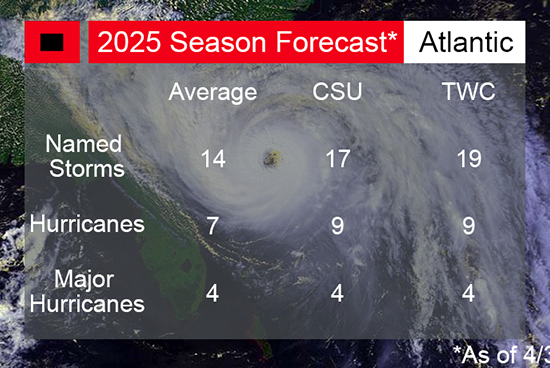
We are now only one month away from the 2025 Atlantic Hurricane Season, and now is the time to prepare your home and family. Forecasts for the upcoming season from The Weather Company and Colorado State University predict an average to above average season in terms of number of named storms, number of hurricanes, and number of major hurricanes.
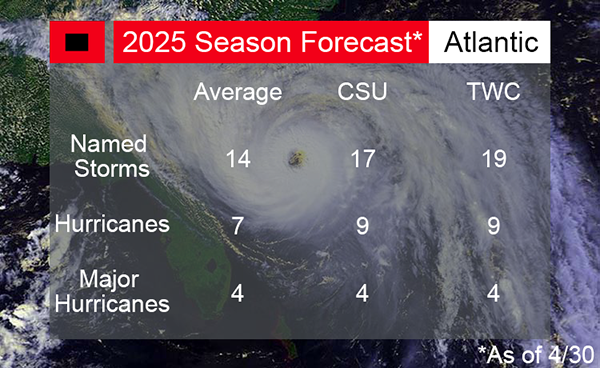
In addition, The Weather Company, owner of The Weather Channel, predicts an above average number of US Coastal landfalls this year as well. There is no indication if those predicted landfalls indicate either coast of Florida, but we know there is a high likelihood of some tropical activity for the state any hurricane season.
While these forecasts are strictly predictions based on factors that may or may not come to pass, these entities have a good track record of being close to the final reported intensity of a season. In 2024, Colorado State University (CSU) accurately predicted 11 hurricanes and 5 major hurricanes. While their named storm prediction of 23 storms was over the final number of 18, it did still align with their prediction of that final number being above the average of 14 named storms.
Regardless of how many storms end up forming in the course of the season, it is just as important to prepare your home and family each and every year. Doing some pre-season prep can save time and frustration if there is a storm coming later on. You can even save money on supplies by stocking up when items are on sale before the season, during the annual storm prep tax holiday, and before scarcity may affect pricing.
Some basic steps to take now include:
Prepare Your Yard
Do any large landscaping and yard trimming projects now while there is time to safely haul yard debris away.
Never trim trees in the days leading up to a storm. Collection will likely be suspended and larger pieces can become projectiles in high winds.
Review Your Emergency Plan
Review important documents, including insurance policies, and determine what documents need to come with you in an evacuation. Creating digital versions may also help safeguard contents.
Create an evacuation plan, if needed. Check your county’s evacuation zone maps in order to determine if you live in a mandatory zone, as it is possible that you will be required to leave your home.
Sign up for emergency alerts from your county’s emergency management department. You can receive text alerts before, during, and after a storm.
Inventory Supplies & Replenish as Needed
Check your emergency supplies. They do not need to be cycled out as frequently as food and water, but it is good to check they are still functional with within expiration dates. This includes things like Batteries, Flashlights, Emergency Radio, Sanitation Supplies, etc.
Cycle out old non-perishable food & water and make sure to have plenty of new food and water when the season starts. Guidelines state having at least 5-7 day supply for each person and pet in your home. For water, this means 1 gallon per person per day.
Check your stock of medical supplies, both prescriptions and first aid. Prescriptions may not be able to be re-filled until right before a storm hits, but check with your doctor and insurance company on best practices on either getting extra before storm season or refilling before a storm hits.
Prepare Your Home
Clean out gutters and other possible flooding locations to improve drainage away from your home.
Ensure you have code compliant protection for all windows and doors in your home.
If your window and door protection is old, failing, not up to code, or difficult to deploy, it may be time to consider upgrading to hurricane impact windows and doors. For a free consultation, request an estimate with our top-rated team of experts.